
The Breakdown: Inter Miami CF
"How Beckham and Messi turned $25 Million into $1.5 Billion"


Note before we start: This piece is co-written with The Private Ledger, the definitive place for private company research.
“I came to America and the MLS 20 years ago with my dream was to win championships, help raise the game of soccer that I love so much, and to build my own team.”
David Beckham, at the opening of Nu Stadium, April 2026
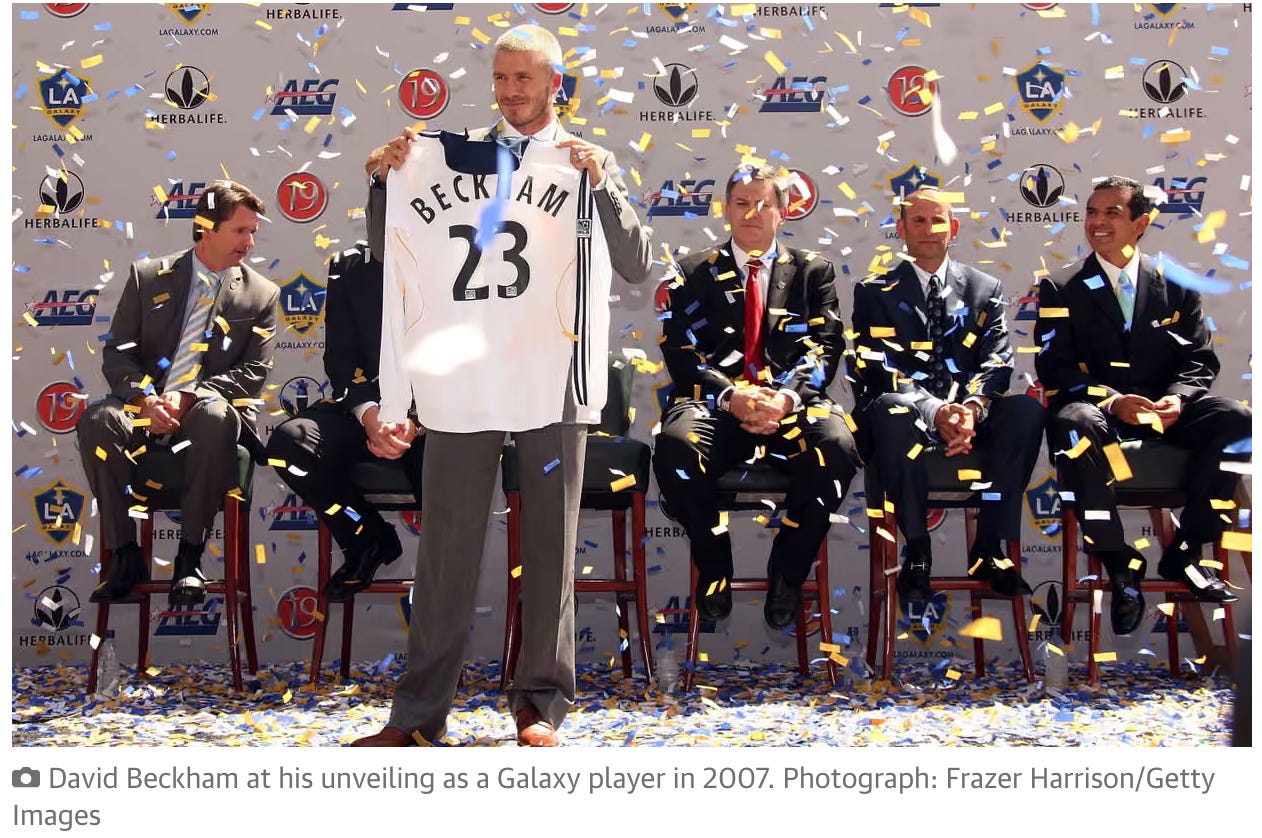
The Clause Nobody Believed In
In 2007, David Beckham took a massive pay cut and a hit to his ego to leave Real Madrid for the Los Angeles Galaxy. Almost everyone laughed and Real Madrid’s own president said Beckham was leaving to become “half a film star.” The headline number was $6.5 million a year, a joke by Madrid standards, and everyone treated it like the whole story. That pay cut is the basis for our story today.
Buried in the contract was a clause giving Beckham the right to buy an MLS expansion franchise for $25 million after his retirement. Commissioner Don Garber has since admitted he viewed it as a symbolic sweetener, a nice line item nobody expected to matter. Twenty years later, that clause is the reason Beckham owns a piece of a $1.35 billion1 soccer club.
At the time, the franchise fee of $25 million wasn’t a steal. Toronto had just paid $10 million the year before to join the league, so Beckham’s number was actually a premium price for a league nobody outside North America took seriously. At Beckham’s retirement in 2013, expansion fees had already climbed to around $40 million elsewhere in the league.
As it turns out, Beckham was also racing against the clock. The initial deal was set to expire December 31, 2013, right as Beckham was searching for a stadium in Miami. Rather than let the deal lapse, the MLS decided to extend the arrangement. According to Beckham himself, the league even called and offered to buy the whole thing back for $50 million, double what he’d paid for it. He said no.
By the time he exercised the option in 2014, expansion fees elsewhere in the league were already running between $70 to $110 million. Every year he waited, the option got more valuable, and it cost him nothing to wait. For reference, St. Louis paid $200 million to join in 2019 and San Diego paid $500 million in 2023. That’s the exact same asset, an MLS expansion slot, that Beckham’s contract had frozen at $25 million sixteen years earlier.
They say it’s better to be lucky than smart and it’s clear that Beckham displayed a little bit of both. Of course, someone with the global name recognition as David Beckham, husband one of the Spice Girls, is likely to increase the value of almost anything he puts his name to. But only a fool could have predicted what happened next.
The Long, Ugly Road to Kickoff, and the Owners Behind It
Before there was a stadium, a trophy, or a Messi, there was a decade of paperwork, politics and two fights, running on parallel tracks. Let’s get into it.
The OG names behind the franchise
As already mentioned, David Beckham is the face and the option holder. But it was Simon Fuller, his longtime business manager, who originally floated the idea of a Miami franchise. Simon stayed on as a partner until Beckham bought him out in 2019 for $50 million. Marcelo Claure, the Bolivian-American, businessman joined as an early partner in 2014 to help get the bid moving and chaired the group at various points. Masayoshi Son, the SoftBank founder and probably most well known for his involvement in the WeWork disaster, joined in December 2017. Finally, two brothers from Miami, Jorge Mas, chairman of the infrastructure and construction giant MasTec, who became managing owner, and his brother Jose Mas, MasTec’s CEO. More on these two later.
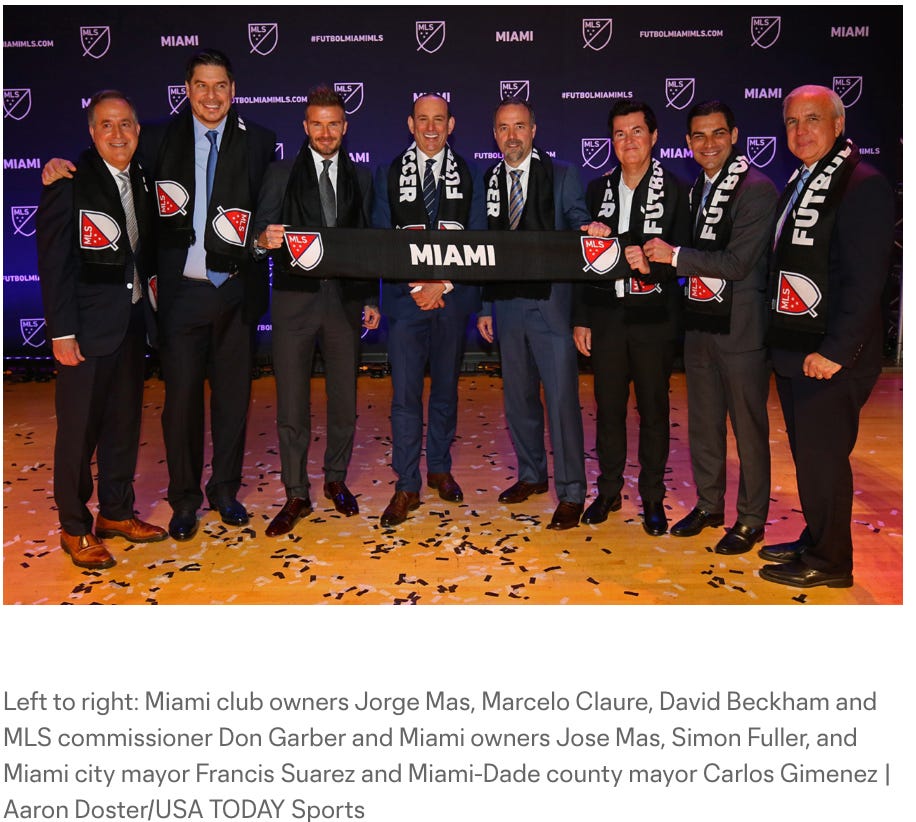
Fight one: the club versus the city
The site everyone wanted was Melreese, a public 131-acre municipal golf course sitting next to Miami International Airport. In 2018, a city referendum passed with 60 percent approval, but that referendum only authorized the city to start negotiating a lease.
What followed was four years of formal political resistance. City Commissioner Manolo Reyes led the opposition and at one point tried to freeze the entire zoning process until a lease was actually signed. The public fight got personal and ugly. Miami Marlins Park critics David Samson and Billy Corben produced a viral video calling the whole arrangement “a real estate hustle,” explicitly comparing it to the widely panned Marlins stadium deal, still one of the most toxic case studies in American stadium financing. Inter Miami’s counter was straightforward: the project was entirely privately funded and would generate more than $2.6 billion in rent payments and 15,000 jobs over the life of the lease.
The lease finally closed in 2022. A 99-year term, four years after the referendum passed, a full decade after Beckham first discussed a Miami franchise with Don Garber.
Fight two: the owners versus each other
While the city fight was playing out publicly, a second fight was happening behind closed doors. In May 2021, MLS hit Inter Miami with a league-record $2 million fine for violating salary cap and roster rules, misclassifying players Blaise Matuidi and Andrés Reyes as non-Designated Players to dodge cap charges they should have carried. Managing owner Jorge Mas was personally fined $250,000 for failing to disclose what he knew and the club’s sporting director was suspended through 2022.
According to reporting from The Athletic, the infraction was reported to the league by Claure himself, one owner effectively turning in the club’s own operating partner. Four months later, in September 2021, the Mas brothers (see above) and Beckham bought out Claure and Son’s combined roughly 48 percent stake, in a deal that valued the club between $600 and $650 million, financed partly with a loan from Goldman Sachs. Ares Management stepped in at the same time with $150 million in preferred equity, the first private equity money to ever go into an MLS club.
The line that ties it together
Two fights, one over land and politics, one over trust and control, both resolved inside the same twelve-month stretch in 2021 and 2022. That consolidation wasn’t cosmetic. It’s arguably the precondition for everything that came next. A club with three aligned owners and a clean cap sheet is a very different operator than a club with four partners and an open MLS investigation, and it’s not a coincidence that the Messi pursuit began in earnest right after this all settled.
From Bottom of the Table to a Trophy Case
Here’s where the story stops being about contracts and ownership structures and becomes, briefly, an actual sports story. Look at where this club actually stood in 2023, the year Messi arrived:
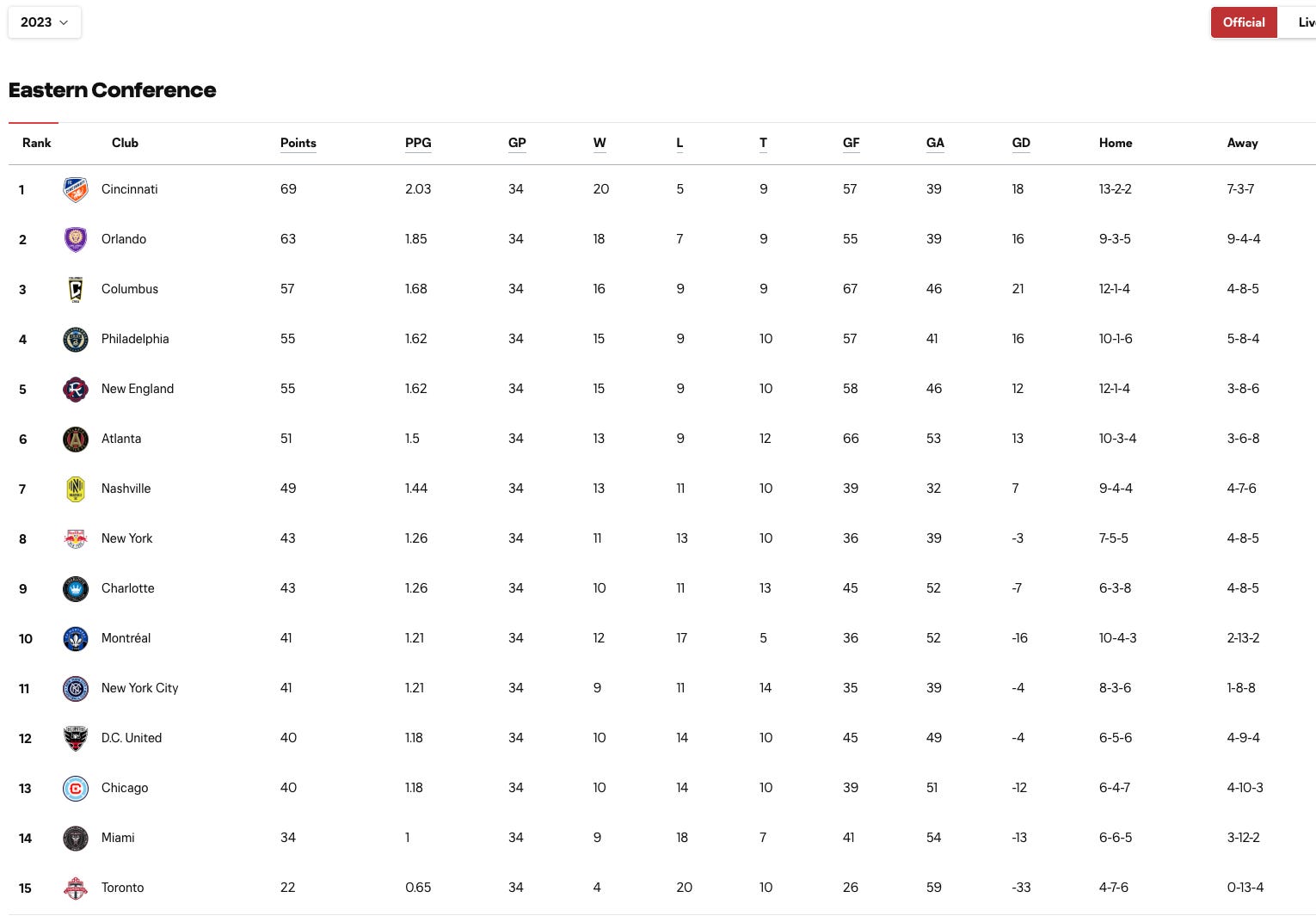
Inter Miami finished 14th out of 15 teams in the Eastern Conference. A 9-18-7 record with a goal differential of negative 13. At that point in time this wasn’t a club quietly building toward something. This was a team that, by any normal measure, was one of the worst in the league.
That context matters, because it’s the entire reason what happened next reads like a Hollywood film (think of it as a sort of Miami Vice) instead of a normal front-office or business success story.
July 21, 2023: the debut
Messi signed at Inter Miami in July 2023, along with Sergio Busquets and Jordi Alba. What followed wasn’t a slow build in interest, it was instant and league-wide. Tickets for his first road match, at FC Dallas, sold out in ten minutes, the fastest sellout in that club’s history, with resale prices climbing past $600 against a $299 face value. This prompted FC Dallas’s co-owner to call Messi’s signing “the greatest coup in the history of the league.” Philadelphia’s home leg against Miami became the most expensive ticket in that franchise’s history, more expensive than any Eagles game sold that season, in a city where American Football is close to religion.
On a personal side, I am an LAFC season ticket holder. As it turns out I had just moved to London in the summer of 2023 and so I was unable to attend the September match between LAFC and Inter Miami. The resale value of that ticket practically paid for my season membership that year.
His first match is a Leagues Cup group game against Cruz Azul and he comes off the bench in the 54th minute with the score tied. In the 94th minute tied, he steps up to a free kick from 25 yards out and ...
It is, by any honest description, one of the most cinematically perfect professional debuts ever. A team sitting near the bottom of the league wins a League’s cup opener on a stoppage-time free kick from the best player alive, in his first appearance, in front of a sold-out stadium.
The trophies since Messi signing:
2023 Leagues Cup: the first trophy in club history, won weeks after Messi’s debut
2024 Supporters’ Shield: an MLS record 74 points in the regular season
2025 MLS Cup: the first league championship in club history, a 3-1 win over the Vancouver Whitecaps
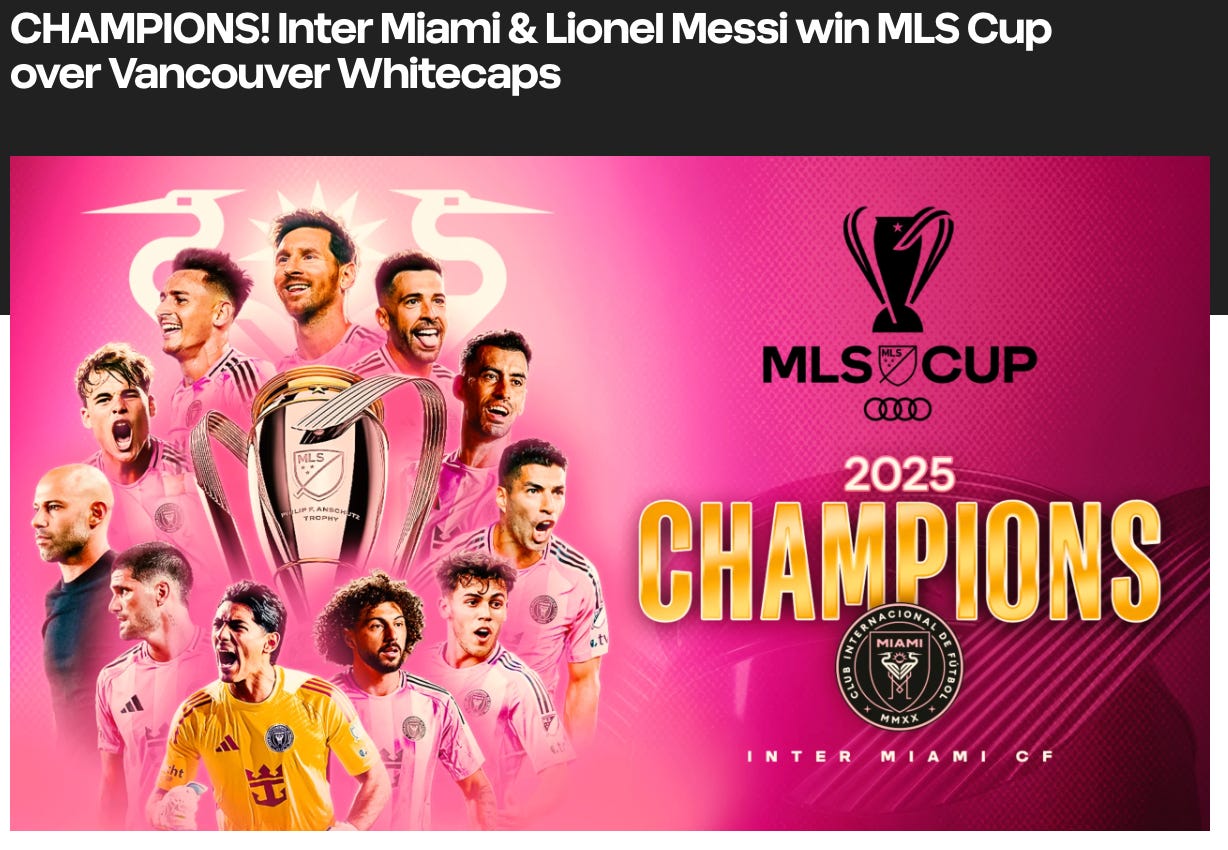
A team that finished 14th of 15 in its own conference in 2023 was hoisting the league’s championship trophy by the end of 2025. That’s a franchise rebuilt from the studs in about twenty-four months, and it happened inside the exact same window that the club’s valuation began its climb toward $1.35 billion. The trophies and the balance sheet moved together, not by coincidence.
The Valuation Story
This is the section where the sports story becomes an investing story.
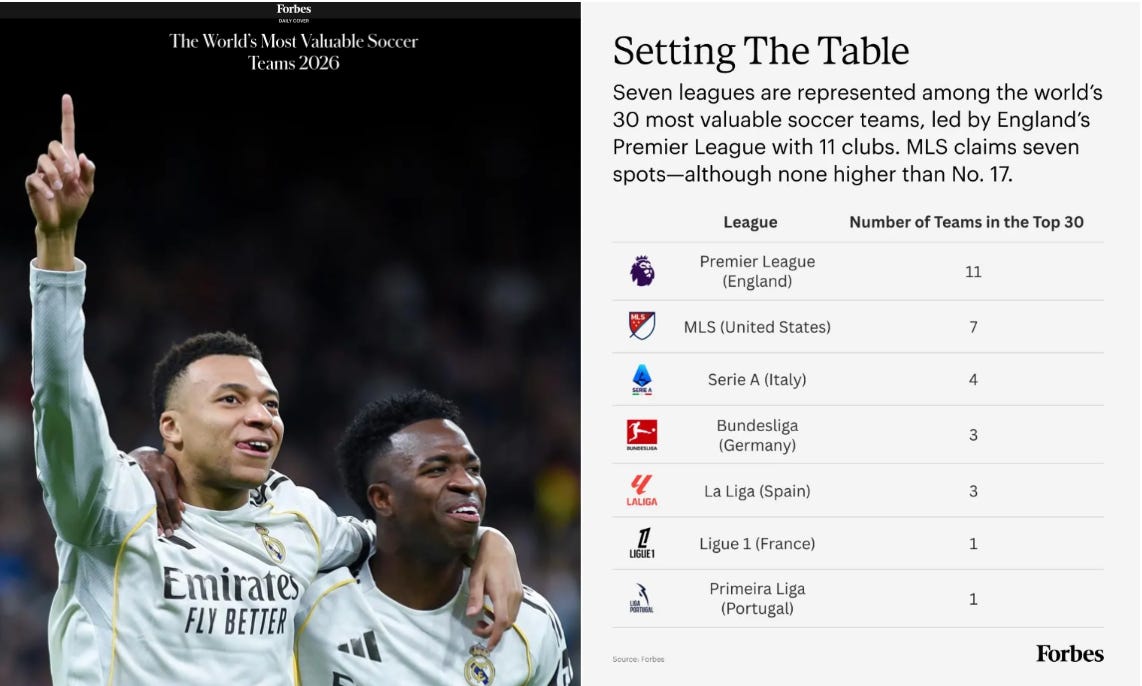
Forbes’s May 2026 rankings put Inter Miami at $1.35 billion, the most valuable club in Major League Soccer, narrowly ahead of LAFC. Not only that, but according to Forbes annual ranking of most valuable football franchises, the MLS, yes the little MLS, now has the 2nd most teams in the top 30 most valuable football franchises, only after the all mighty Premier League. A rising tide lifts all boats.

The revenue trajectory underneath that number tells the real story. In 2022, the year before Messi, the club generated somewhere between $50 and $56 million. In 2023, the year he arrived midseason, that nearly doubled to $118-130 million. By 2025, it was $200 million and the projection for 2026 sits around $250 million. That’s over a fourfold increase in revenue in three years, off the back of one signing.
What kind of asset this actually is
Inter Miami is, functionally, a late-stage private company. No public shares, no ticker, no quarterly filings, just periodic marks from Forbes and other independent valuators based on comparable transactions and disclosed revenue. In that sense it sits in exactly the category Joseph tracks every week at The Private Ledger, a private, growth-stage asset whose valuation moves in step jumps rather than along a continuous public tape.
Let’s spend a few minutes to review what caused the step jump. The overall product was the same, 11 players on a pitch trying to score goals. There wasn’t a new funding round since 2023 that repriced the value of the club. It was a single free transfer signing of an aging player who had been a relative disappointment in his last European club, my beloved PSG. Messi didn’t just make Inter Miami better at soccer, he was effectively a blockbuster in an Adidas jersey. Revenue tripled, Messi’s Inter Miami jersey became the most sold on the planet and the social media follower base went from irrelevant to top-five in North American sports within six weeks. All this and more caused the valuation to re-rate from the $585 million range to $1.35 billion in under three years.
Revenue breakdown2:
Sponsorship: roughly $60 million in 2024, nearly double the prior year and more than 3x the MLS club average of about $17 million. Key names on the shirt and around the stadium: Royal Caribbean, Visa, Duracell, XBTO
Ticketing: some of the highest pricing in the league. Standard season seats ran $867 to $2,720 in 2024, club seats up to $13,000, suites as high as $42,840
Merchandise: Messi’s Inter Miami jersey became the best-selling jersey in Adidas’s entire global sports portfolio, not just in MLS, across every sport and every league Adidas sponsors
The social media dominance
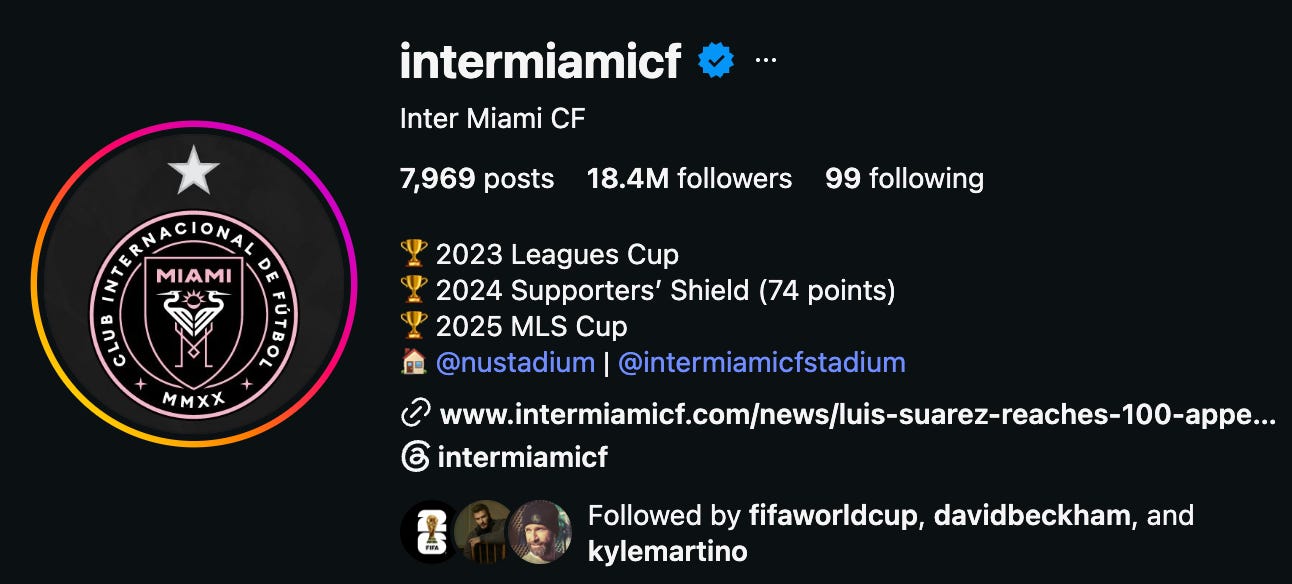
Before Messi ever kicked a ball for the club, Inter Miami had already out-followed the Dallas Cowboys, the American Football team with the largest social media following. In June 2023, the club had about 900,000 Instagram followers. Six weeks after the Messi announcement, that number was 10.4 million, already the fourth most-followed franchise in American sports on Instagram, ahead of every NFL, NBA, MLB, and NHL team, before he had played a single match. As of 2026, Inter Miami generated more total social value than any NBA, NFL, or MLB franchise, according to Zoomph’s engagement-based measurement, despite posting less frequently than several of them. That’s a distribution story, and distribution is the thing sponsors actually pay for.
How this stacks up against Europe’s giants
This is where the number really lands. Using Forbes’s 2026 figures: Real Madrid sits at a $9.5 billion valuation on $1.27 billion in revenue, the first club in any sport to cross $1 billion in revenue in a single season. Barcelona is around $7.5 billion, having crossed $1 billion in revenue for the first time last season. Manchester City sits in the $900 million to $1 billion revenue range.
Inter Miami, by comparison, is generating just over $200 million in revenue on a $1.35 billion valuation. Interestingly, the revenue gap is enormous, but the valuation gap is nowhere near as wide. Inter Miami are now being traded at a similar revenue multiples to clubs like Barcelona, Real Madrid and Liverpool, storied franchises that have been the heart and soul of their cities for years. The fact that they are shows how valuable Inter Miami is being viewed as a club that has long term potential to cement itself not as a passing fad but rather as a future football cornerstone.
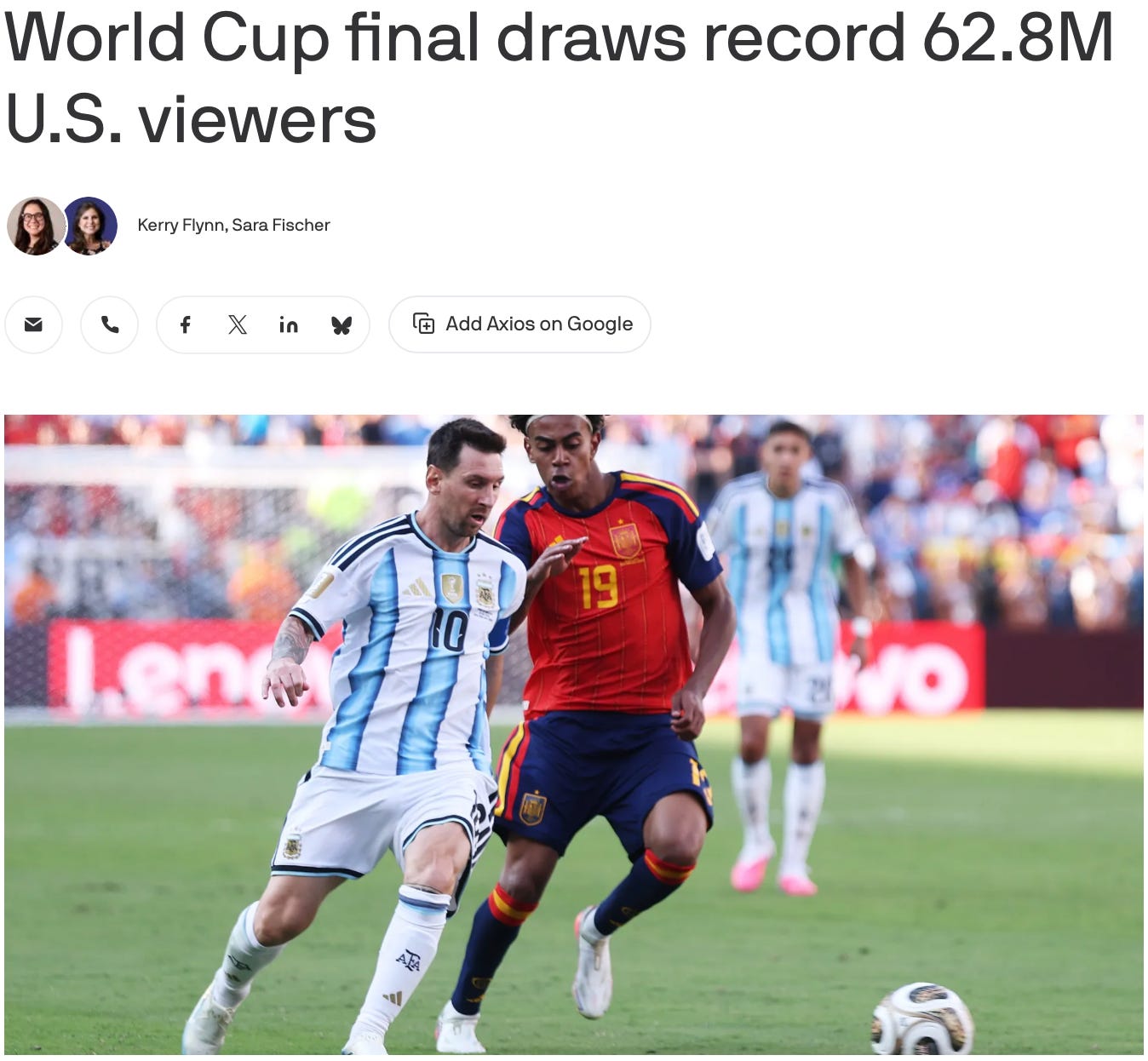
As you know, and probably spent the large parts of the past few weeks watching, the US was one of the co-hosts of the 2026 FIFA World Cup. Despite a disappointing end to their campaign, it does appear to have been quite a media success in the country and hence it will be interesting to follow what sort of effect that has on the continued growth and success of the MLS in general and Inter Miami in particular.
Why the Whole League Is Repricing
Zoom out from one club to the whole league for a moment, because Inter Miami’s number doesn’t exist in a vacuum. The MLS, as an entire league, is being repriced.
The league-wide numbers
MLS’s 29 clubs are collectively worth $20.9 billion, up 6 percent year over year, according to Sportico. Five clubs, LAFC, Inter Miami, LA Galaxy, Atlanta United, and NYCFC, are now valued above $1 billion. Two years ago, in 2023, that number was zero. As you can see, according to Forbes, the MLS has the second most franchises in the top 30.
A personal data point
I can vouch for part of this one directly, as an LAFC season ticket holder. When Inter Miami comes to town, resale prices on our own tickets run three to five times what they go for against most other opponents in the league. That’s not a Sportico model or a league press release, that’s the Messi effect.
The league-wide attendance data backs this up. Messi’s Inter Miami drew club-record road crowds wherever it traveled in 2025, 72,610 fans in Kansas City and 65,612 in Foxborough, part of a leaguewide regular season attendance total of 11.45 million, itself up 6 percent year over year. Sponsorship revenue across the whole league rose 13 percent in the same period, ticket revenue rose 12 percent.
Why institutional capital is willing to underwrite this
A few structural features make MLS a genuinely different bet than a European club, and they matter more to the valuation than any single player:
A single-entity ownership model, where the league itself owns player contracts and controls costs centrally, rather than each club bidding against itself in an open market the way European clubs do
No relegation, which removes the single biggest source of downside volatility in world soccer. A bad season in the Premier League can cost a club its entire television revenue overnight. That risk doesn’t exist in MLS
Together, these give institutional investors like Ares Management something closer to a stable, contracted cash flow profile than the boom-bust cycle that scares most capital away from European clubs
None of this should be read as “MLS is suddenly profitable.” Over half of MLS clubs still operate at a loss, and the $2.5 billion Apple TV deal, while transformative on the revenue line, carries high production costs that eat into near-term economics. This is a valuation story, not yet a cash flow story. Think of it as the playground for the uber wealthy who get to live out their childhood dreams by sitting courtside or in the luxury box suites, rather than on the pitch.
Note: Although this article is about Inter Miami, another interesting case study is that of Wrexham A.F.C. and the success both on and off the pitch that Ryan Reynolds, Rob McElhenney have had since purchasing the club in November 2020.
The Apple Deal vs. Europe
Let’s take a little detour and examine the recently signed Apple TV deal. This is not simply an Inter Miami story, although clearly it is driven in large part by Inter Miami’s success and the signing of Lionel Messi. The trajectory, not the current number, is the actual story.
What MLS has now versus what it had before
MLS signed a 10-year, $2.5 billion deal with Apple, roughly $250 million a year. That’s up from the old fragmented setup of about $65 million a year in national rights split across ESPN, Fox, and Univision, plus roughly $84 million a year in aggregate local team deals. Call it $90-100 million a year total under the old model. The Apple deal is a genuine structural change too, not just a bigger check. It’s the first time any major American sports league has put every single game behind one global streaming platform with no local blackouts.
How that stacks up against Europe
Let’s be honest, there’s still a gap, and it’s a big one. Deloitte publishes an Annual Review of Football Finance. Here are some charts from the 2026 edition:
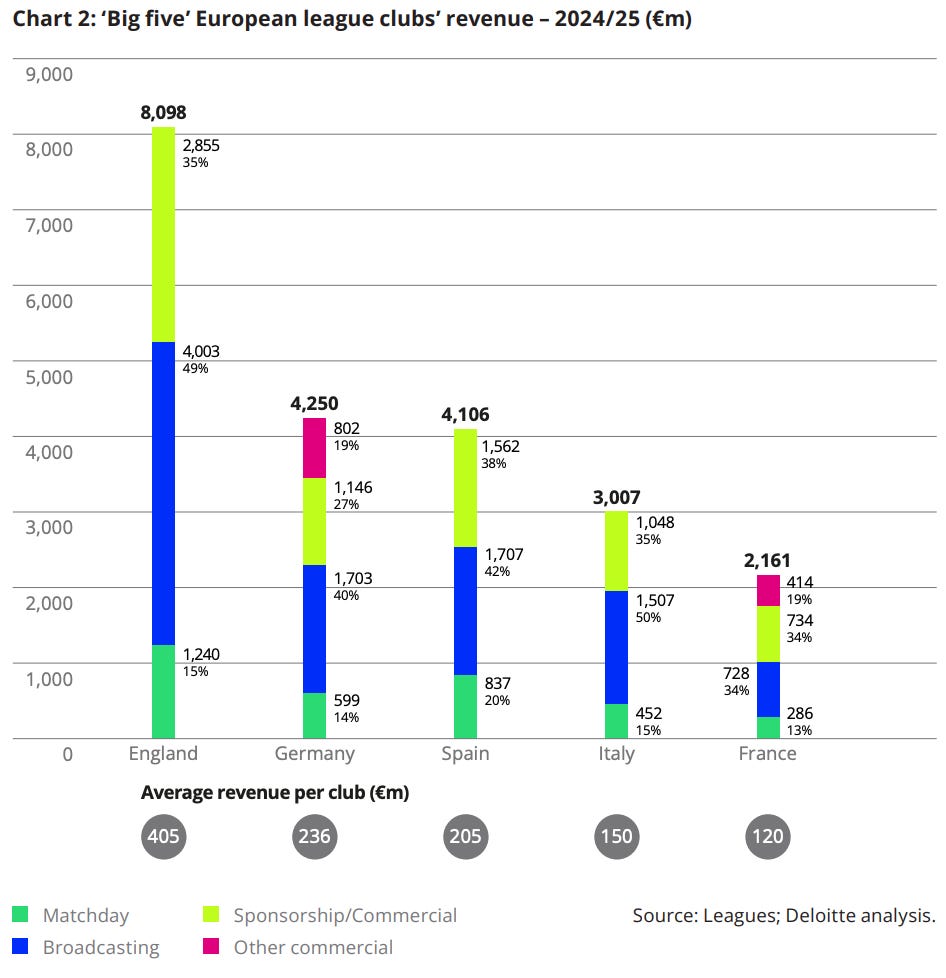
As you can see above, MLS’s entire ten-year deal is smaller than what the Premier League collects domestically in a single season. That being said, what matters more than the current gap is the direction of travel.
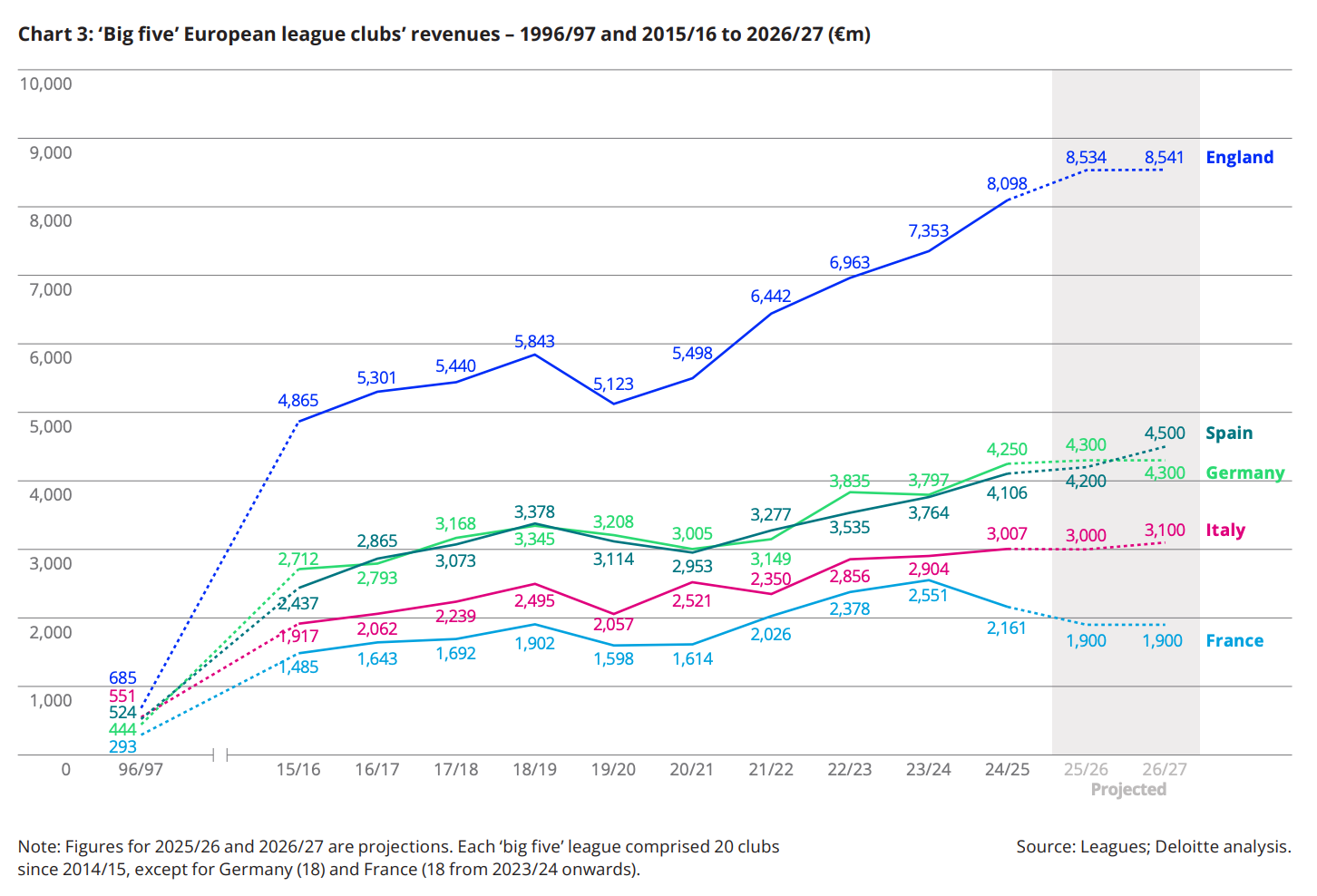
As you can see from the chart above, European club revenues growth is rather low, led by disappointing domestic media rights renegotiations. In some countries revenues have even been flat to declining in real terms (see France, Italy and Germany). Meanwhile, MLS just tripled its own number in a single negotiation, and built in a subscriber revenue-share mechanism once Apple’s Season Pass hits an undisclosed threshold, meaning there’s real upside baked into the deal that Europe’s flat contracts don’t have.
European soccer’s media rights problem is a warning sign for a mature, saturated market running out of ways to grow. MLS’s Apple deal is a young market getting its first real floor to build from. Those are opposite trajectories, even if the current dollar figures make MLS look like the smaller player in the room.
Where To From Here
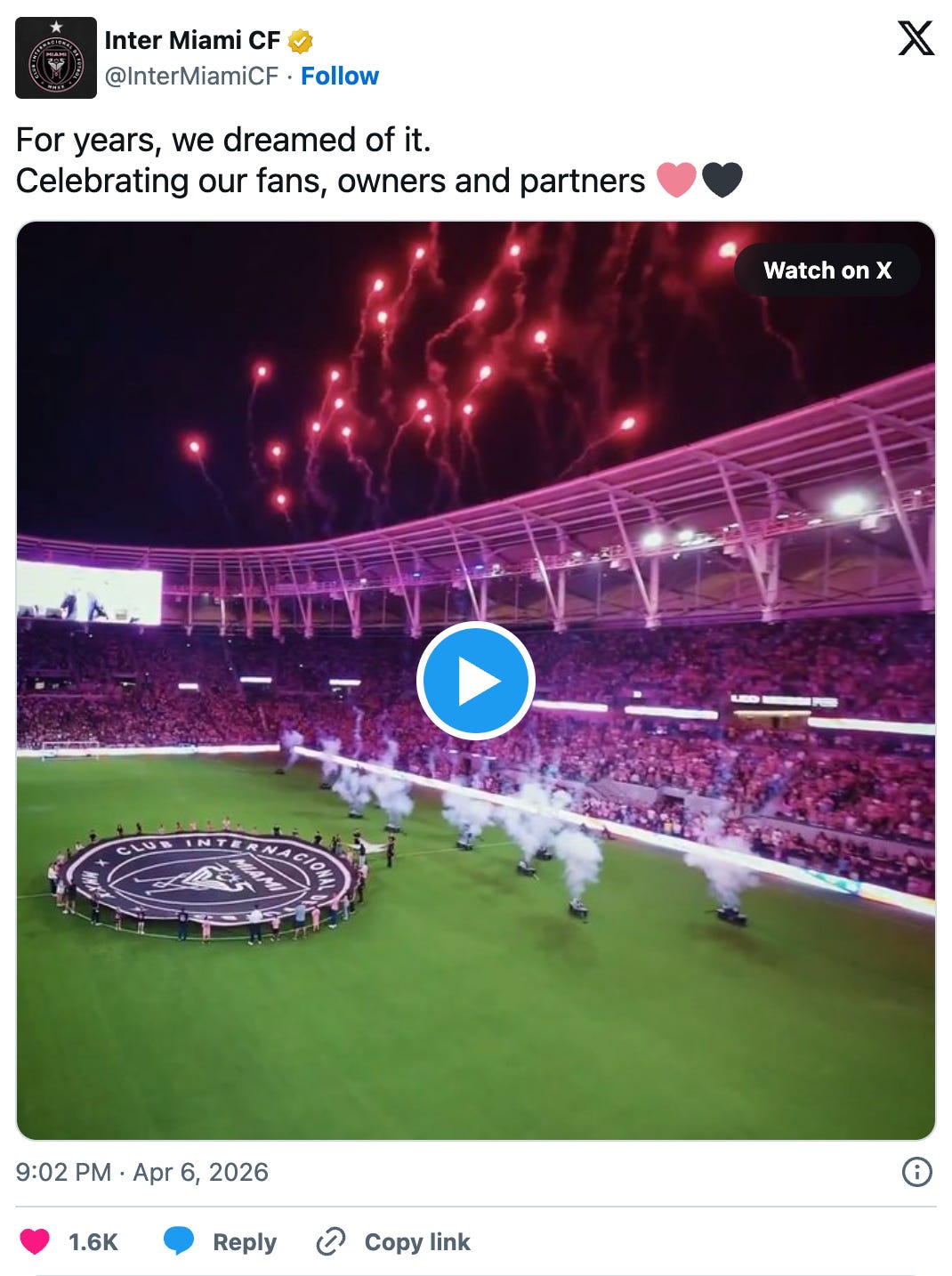
Inter Miami’s Nu Stadium debuted on April 4, 2026, a 26,700-seat, privately funded, soccer-specific venue, replacing the temporary Chase Stadium in Fort Lauderdale that the club had used for its entire first six seasons. Chase Stadium’s capacity sat around 21,550, with a 2024 season average closer to 20,700. Nu Stadium represents something like a 25 to 30 percent step up in per-game capacity, and unlike Chase, it’s permanent and owned rather than leased.
Opening night drew 26,412 fans, essentially a sellout and Beckham himself spoke at the opening: “I came to America and the MLS twenty years ago with my dream was to win championships, help raise the game of soccer that I love so much, and to build my own team. Thirteen years ago, I announced Miami was my choice. We had no name, we had no badge, we had no stadium. Today, I stand here in our new home.”
Let’s recap what just happened, a 5,000-plus seat increase per game, sold close to capacity from night one, is itself a real, measurable read on whether demand holds independent of the next headline signing.
The post-Messi question
This is the single most important question hanging over the entire valuation, and it deserves to be stated. There are two models for what could possibly happen when Messi eventually retires or moves on.
Call the first the Musk model: a singular, irreplaceable operator arrives, radically re-rates the asset through sheer personal gravity, then leaves, and the re-rating partially or fully unwinds because the value was the person, not the institution.
Call the second the Berskhire model: the star is the founding event, but the infrastructure built during his tenure, the stadium, the sponsorship base, the global follower count, the reputation as a destination club, outlives him, the way Berkshire Hathaway will continue to exist now that Warren Buffett and Charlie Munger are no longer day to day operators.
The evidence right now genuinely cuts both ways. The fact that nearly every trophy, every attendance record, and every sponsorship jump traces directly back to one 39-year-old’s body argues for fragility. Messi’s contract runs through 2028, reportedly with an equity conversion option, unconfirmed publicly at any specific percentage, a fundamentally different structure than the fixed-price option Beckham used back in 2007. Worth noting: even the mechanism for keeping stars invested has evolved from “buy a team outright” to “convert into equity,” which is its own quiet signal about how this asset class has matured.
Time will tell how this plays out, but it’s certainly a question worth posing. On a more investable note, any Elon Musk related company will face the same questions if/when he does step away from Tesla, SpaceX and any other venture he has been actively involved with that has a ticker listed on a stock exchange.
Soccer’s 30-year promise, and whether this time is different
The World Cup ended on July 19, 2026, and the tournament has revived a question American soccer writers have been asking since 1994: does this finally stick? The optimistic case has real substance behind it. Unlike 1994, MLS isn’t starting from zero, it’s a mature domestic league with a much younger, more engaged fan base than it had a decade ago, and sports betting and streaming money have created durable commercial infrastructure that simply didn’t exist during any prior soccer boom in this country.
There's a second tailwind nobody's talking about enough. In 2018, the Supreme Court struck down the federal ban on sports betting, and the door blew open. Add the rise of prediction markets on top of that, and now anyone in the US can put real money on an MLS match in about four taps on their phone. Betting is one of the clearest drivers of sports franchise valuations we have, full stop. More action means more eyeballs, more eyeballs means more rights fees, more rights fees means a bigger number on the valuation sheet. The Private Ledger and I actually dug into this exact mechanism in a joint piece on Polymarket, the upside it's created and the real damage it's doing underneath, which you can read here.
One more thing worth flagging. MLS has been running on the wrong clock. Its season goes February to December, backwards from every major European league. Starting in 2027, that changes. The league is shifting to a fall-to-spring calendar, the same rhythm as the Premier League, La Liga, and Serie A, and the timing isn't cosmetic. It puts MLS on the same transfer calendar as the clubs it's actually competing against for talent, which means when a player or manager's time in Europe runs out, MLS is finally standing in the room at the right moment to make an offer, instead of showing up six months late.
The uniquely American wrinkle
The skeptical case is worth taking seriously too. Once Messi leaves, an entire fan base leaves with him. In a country that has four major sports leagues all competing for valuable time, a fifth league that isn’t entrenched in the country's history may have a tough time succeeding.
Competition within a city for different sports teams is a uniquely American problem and one that is worth focusing on. Inter Miami isn’t just competing globally for soccer relevance, it’s competing locally against the Heat, the Marlins, the Dolphins, and the Florida Panthers, four franchises with decades of entrenched loyalty in the same media market. In Madrid or Barcelona, soccer has no domestic rival for the sports calendar. In Miami, Inter Miami has to win attention inside a genuinely crowded local market before it even gets to compete for a global audience. That’s a hard task, and it’s a reasonable explanation for why the club leans so heavily on global rather than purely local audience capture.
There's a harder version of the skeptical case worth stating plainly. The US had every card stacked in its favor for this 2026 World Cup: home soil, the biggest stage in the sport, and what many considered a golden generation of young American talent given the large number of players plying their trade in top European leagues. If soccer in America was ever going to break through, this was the setup for it. Whatever verdict comes out of this tournament is likely the one that sticks for a while, because the calendar doesn't offer a quick do-over. The USMNT has other competitions on the schedule, Gold Cups, Nations League windows, friendlies, but none of them command anywhere near the same attention, and casual viewers know it. The next World Cup is four years away. That's a long runway either to build on real momentum, or to watch this moment fade the way 1994's did.
What This Actually Teaches You
Nobody reading this will ever get to invest in Inter Miami or a similar franchise. It’s private, closely held, and not for sale, not to mention that it now carries a 10 figure price tag. So the value of this piece isn’t “go buy this asset,” it’s what the mechanics underneath it teach you about decisions you’ll actually face.
Let’s examine five lessons we can learn from the breakdown of Inter Miami:
The hidden clause often beats the headline number.
Everyone covered Beckham’s surprising move and cut rate salary in 2007 as he was one of the biggest names in the sport. Nobody covered the option clause and yet two decades later, the sweetener is worth more than the salary ever could have been. In your own life, where can you find a sweetener that is actually worth more than it initially looks. Perhaps when deciding between two job offers location is actually more important than the slightly higher salary. That extra hour that you get to spend with your kids every day is actually the most valuable hidden “bonus”.
Fix your price while the asset is unloved.
Beckham locked a fair (possibly even slightly inflated) number in 2007 and let the market reprice around it for years. The advantage wasn’t spotting a discount, it was having the conviction to commit before consensus formed. Warren Buffett’s quote "Be fearful when others are greedy, and greedy when others are fearful" comes to mind here. Covid-19 was simultaneously a horrible pandemic and also a time when you could get cheaper mortgage rates that you could lock in for decades, or stocks at a cheaper valuation.
People get mispriced the same way businesses do.
One signing re-rated Inter Miami’s revenue, followers, and valuation all at once. A genuinely exceptional hire is usually still underpriced relative to what they’ll do to everything around them. This is fair, because generally organizations are bigger than one person, but sometimes they do make all the difference. Think Steve Jobs’ return to Apple in 1997.
Distribution beats the product.
MLS didn’t get four times better on the field between Beckham and Messi. Yet its audience did grow by multiples. Better distribution outperforms a better product more often than people want to admit. Amazon learned this and leaned into it hard to become the world’s largest retailer in the space of a couple of decades. For those thinking of starting a business (or a Substack), the writing is the easy part, getting people to read your work is the real work.
Talent recruits talent.
Beckham made MLS a plausible destination. Messi did it again at scale (and in the immediate aftermath of his signing he brought in two other major stars to join him at Inter Miami). The same pull showed up this summer around a World Cup goalkeeper nobody had heard of a month earlier. One great hire changes who says yes to you next.
The Falsifiable Close
Here’s the actual bet embedded in a $1.35 billion valuation: that Inter Miami has become an institution, not just a star vehicle. Everything else in this episode, the stadium, the sponsorships, the follower count, is either evidence for that bet or evidence against it. What the Inter Miami story teaches us, is that many companies face a tug of war between the power of the institution/brand and the power of the individual.
2026 Inter Miami’s case for institution:
The club now has more Instagram followers than every NFL, NBA, MLB, and NHL team except three.
It has a football specific, sold-out, privately owned stadium.
It has sponsorship revenue running 3x the league average and a jersey program dominant enough to lead Adidas’s entire global portfolio, not just its soccer business.
None of that disappears the day Messi stops playing, but it certainly could weaken over time. Which brings us to…
Inter Miami’s case of the power of the individual:
Nearly every number in this episode traces back to one 39-year-old.
Nearly all of the franchise’s growth happened in the three years since he signed.
Take him out of the picture and there’s no clean precedent for what an MLS club’s valuation does on the other side.
Beckham’s $25 million clause already proved one thing beyond argument. A correctly priced option on an unloved asset, held with enough patience, can outperform almost anything else available to an investor. Whether Inter Miami itself becomes the second proof point, of a club that outlived its founding superstar, or the cautionary counterexample, is a question the next three years will answer, not this episode.
According to Forbes’s 2026 annual ranking: https://www.forbes.com/sites/justinteitelbaum/2026/05/29/the-worlds-most-valuable-soccer-teams-2026/
Since Inter Miami is a private company, these are estimates obtained from credible 3rd party estimates such as Sportico, Forbes, CNBC/Deloitte, ESPN
 | A guest post by
|
This was a fun post to work on!
Thank you Marc :)